A short history of Manotick
The village exists because of the mill. Moss Kent Dickinson and Joseph Merrill Currier built the stone grist mill on the Rideau in 1860, and the settlement that grew around it took its name from an Algonquin Anishinàbe word meaning 'island' — after the island in the river beside which the mill was built. The village sits on unceded Algonquin Anishinàbe territory.
.jpg)
The mill and the legend
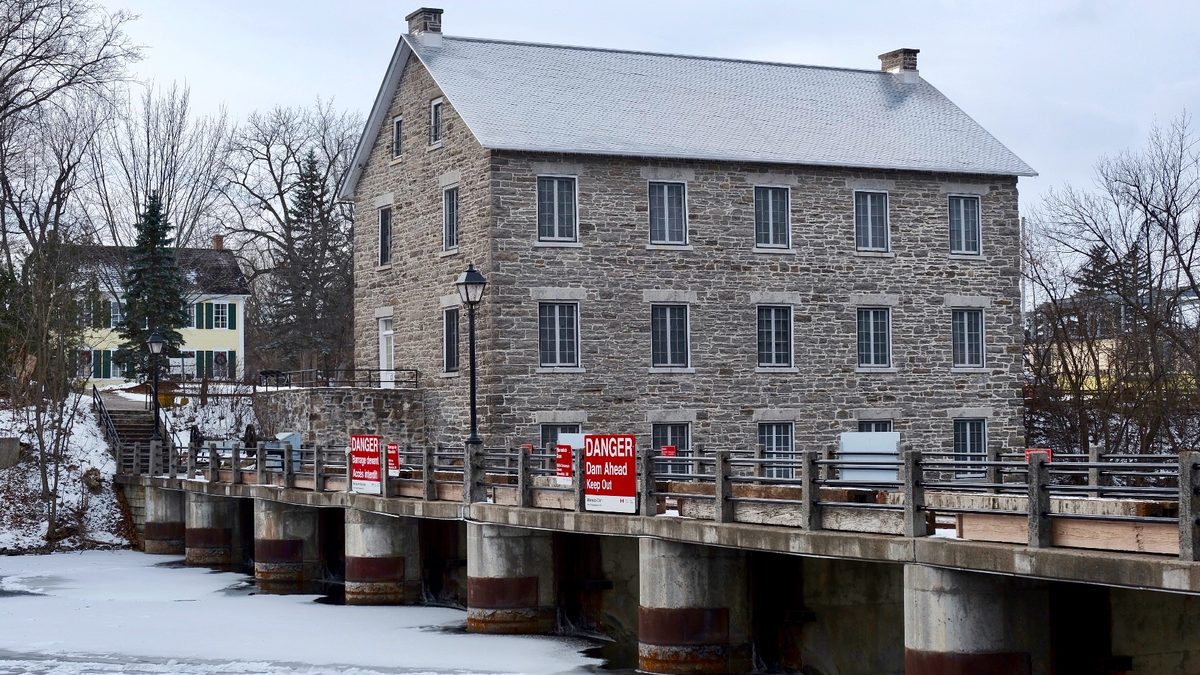
Watson's Mill, at 5525 Dickinson Street, still stands and still grinds — one of the very few operating 19th-century grist mills left in North America, and the village's defining landmark. It carries a famous ghost story, and an unusually grim one. Ann Crosby married Joseph Currier in January 1861. Within a few months, by the museum's own account, she was descending the stairs from the attic to the second floor when her skirt caught in a revolving drive shaft; she was pulled off her feet and thrown against a support pillar, and killed. Sources disagree on the exact date — February and March 1861 both appear in print. Currier sold his share of the mill to Dickinson and, by most accounts, never worked there again. Ann's presence in the second-floor windows has been part of village lore ever since.
What Dickinson and Currier actually built
Not one mill — a complex. A British survey identified the site as ideal for milling as early as 1794, but nothing was built until Dickinson and Currier leased the water rights from the federal government in 1859 at $50 a year plus thirty acres. The control dam was finished in August 1858 and rebuilt in concrete in 1956. Then in quick succession: a sawmill in 1859 (burned 1887), the flour and grist mill in 1860 — the building standing today — a wool carding mill in 1861 (burned 1879), and a bung, plug and spile mill in 1875. The mill was built by contractor Thomas Langrell from Rideau River limestone, and its five turbines were cast at Currier's own Victoria Foundry. At capacity the Long Island Flouring Mills could grind a hundred barrels of flour a day, and the sawn lumber went to the American market.
The two men were not small figures. Moss Kent Dickinson was a forwarder and steamboat operator known as the "King of the Rideau", Mayor of Ottawa from 1864 to 1866 and later MP for Russell; he registered the village plan with Carleton County in 1862 and died at Manotick in 1897, heavily in debt. Joseph Merrill Currier was a lumber baron and foundry partner who sat in Parliament and later became Ottawa's postmaster. He withdrew from the Manotick firm in 1863.
Who was Watson?
The mill is not named after its builders, which surprises people. The Spratt family leased and then bought it in the 1920s and ran it as a feed store. Harry Watson — who came from England in 1924 under the Barnardo Boys scheme and had been the mill's manager for the Spratts — bought it in 1946, and one of his first acts as owner was to rechristen the building Watson's Mill. He bought the house in 1948 and also ran an International Harvester dealership and a fuel-oil business. The mill marked a century of operation in 1960 and commercial flour grinding stopped in 1963.
How it was saved, and what it is protected by
In 1963 the National Capital Commission entered a lease with Harry Watson to preserve the mill, the house and the carriage shed, and restoration back to an 1860s water-powered mill began. In 1972 the Rideau Valley Conservation Authority bought the property, on the condition that the mill remain known as Watson's Mill. It opened to the public as a museum in 1974.
The designation is worth getting right, because it is often reported wrongly. The mill and Dickinson House are designated under Part IV of the Ontario Heritage Act — individual property designation, By-law 32-79, dating to 1979. Watson's Mill is not a National Historic Site; the national and UNESCO designations in this area belong to the Rideau Canal, which was inscribed as a UNESCO World Heritage Site in 2007 and is also a National Historic Site. There is no Heritage Conservation District in Manotick.
In 1997 volunteers formed Watson's Mill Manotick Incorporated, and in 2008 the City of Ottawa bought the three-building Dickinson Square complex and transferred ownership to WMMI, which runs it today.
Dickinson Square: three buildings, not one
Watson's Mill (1860) is the working water-powered grist mill and the museum. Dickinson House was built as the mill office, general store and post office, became the Dickinson family residence in 1870, and went on to house every subsequent owner of the mill; it is a heritage house museum now. The Carriage Shed was converted to office space after the RVCA purchase and today holds administrative offices and the Used Book Store. Together the three are Dickinson Square.
Visiting
The mill is at 5525 Dickinson Street, phone 613-692-6455. The 2026 season runs 16 May to 7 September, Wednesday to Sunday 10:00–16:45, then 12 September to 11 October, weekends 10:00–16:00, with special events only through to early December and closed over the winter. Admission is by donation, $3 suggested, covering both the Mill and Dickinson House; children 12 and under free. Public milling demonstrations run Sunday afternoons, roughly 1 to 3pm, May through October — the mill still grinds, and the stone-ground whole wheat flour is sold on site, from $10 for two pounds. The Used Book Store is in the Carriage Shed, and there is a self-guided historic walking tour of the village. Season dates and demonstration schedules shift, so check the mill's own calendar before driving out.
From mill village to estate community
Manotick spent a century as a rural service village before Ottawa's growth reached it. Amalgamation into the city in 2001, the rise of the estate subdivisions, and lately the Mahogany development have layered a modern community onto the historic core — with Dickinson Days each June still celebrating the founder.
Common questions
What does Manotick mean?
The name comes from an Algonquin Anishinàbe word meaning 'island' — a reference to the island in the Rideau River beside which the mill was built. It is often misattributed to Ojibwe; the two are related Anishinaabe languages, but this is Algonquin Anishinàbe territory and that is the correct attribution.
Is Watson's Mill a National Historic Site?
No, and this gets reported wrongly a lot. Watson's Mill and Dickinson House are designated under Part IV of the Ontario Heritage Act — individual property designation under By-law 32-79, dating to 1979. The National Historic Site and UNESCO World Heritage designations in this area belong to the Rideau Canal, which was inscribed by UNESCO in 2007. There is also no Heritage Conservation District in Manotick.
Who was Watson, if the mill was built by Dickinson and Currier?
Harry Watson bought the mill in 1946 and renamed it after himself — one of his first acts as owner. He had arrived from England in 1924 under the Barnardo Boys scheme and had been the mill's manager for the Spratt family, who owned it through the 1920s and 30s. When the Rideau Valley Conservation Authority bought the property in 1972 it did so on the condition that the building keep the Watson name.
When did the mill stop grinding commercially?
1963, three years after it marked a century of operation. The National Capital Commission entered a preservation lease with Harry Watson that same year and restoration back to an 1860s water-powered mill began. It opened as a museum in 1974. It still grinds — public milling demonstrations run Sunday afternoons from May through October and the flour is sold on site.
When can you visit Watson's Mill and what does it cost?
The 2026 season runs 16 May to 7 September, Wednesday to Sunday 10:00 to 16:45, then weekends only from 12 September to 11 October, with special events through to early December. Admission is by donation with $3 per person suggested, covering both the Mill and Dickinson House, and children 12 and under are free. Milling demonstrations run Sunday afternoons roughly 1 to 3pm. Check the mill's calendar before driving out — dates shift year to year.
Can you visit Watson's Mill?
Yes. It operates as a museum from mid-May to mid-October, Wednesday to Sunday in high season and weekends into the fall, with admission by donation. Check the mill's own calendar before driving out — the season dates and the special-events schedule shift year to year. It still grinds flour — public milling demonstrations run Sunday afternoons, roughly 1 to 3 p.m., May through October, and the stone-ground whole wheat flour is sold on site.